

For leftist governments in Latin America, it is essential to stop the extractivist stealing of natural resources enabled by colonial legacy, weak legislation and corrupt contracts that help foreign corporations drill and mine at will. It’s why nationalisation is preferred over simple royalties.
Our region is abundant with riches considered “strategic” or “critical” to the rest of the world. Thea Riofrancos, author of the book Extraction, highlights that these terms are not random, but have a bellicose origin. Minerals and fuels are strategic not only because they can be used for important technology and development purposes, but also because they are not equally distributed. Some territories - and as a consequence, countries - have more of some than others. Therefore, in the geopolitical terrain, it is also important to secure access to these resources, even if they are sitting in/on land that is not yours.
Obviously, knowing the history of modern wars, we know that fossil fuels have played a strong role in the killing-for-resources machine. These are not often justified as the pursuit of oil, though. Although imperialism is profoundly illiberal, given that it operates through violence, authoritarianism, and domination, we witnessed a long period of imperial intervention justified on liberal terms. European nations that were responsible for slicing up entire territories, dividing up peoples, and plundering nature for resources during colonial times, later preferred to support war incursions, spying and political unrest in the name of freedoms, human rights, democracy and stability. How these terms were defined mattered little, as long as you could hold them to a higher stance and use them to lend legitimacy to some pretty illegitimate acts.
The United States, however, was the country to perfect this system. At the same time that it toppled democratic governments in the Global South to establish US-friendly dictatorships, it instrumentalised the ghost of communism to claim that real freedom was capitalist freedom, with the US as its major representative. This logic supported a narrative that still lives strongly in peoples’ minds. Whereas other countries ought to respect each others’ sovereignty and avoid intervening - unless it is done collectively through multilateralism and diplomacy - the US was different. Its fictional superheros are responsible for the whole world. When a meteor approaches, it is up to the US president to announce it to the Earth. When aliens arrive, it is the US politicians and scientists they want to meet. Our fictionalised planet is based on a version of reality where the US proclaimed itself responsible for the world, just so it could take on the whole world.
Venezuela
Which brings me to the Venezuelan case. Whereas a lot of the narrative surrounding the last years in Venezuela concerned the 2024 elections and whether Nicolás Maduro had indeed won the presidency, Donald Trump's recent acts show that he is not concerned at all with pretending that he toppled some dictator to establish democracy, as was the trope of his predecessors’ interventions in the Global South. Even Maria Corina Machado, the leader of the Venezuelan right-wing opposition, was sidelined by Trump, who claimed she did not have the support needed to govern Venezuela at this time.
If Trump had been convinced the narrative of bringing in democracy was important, he would have surely tried to highlight Machado and promote Edmundo González Urrutia as the rightful winner of the 2024 election and claim that he would be the next president instead. This is what Macron did, after all, and it would have been aligned with the strategy encamped by Juan Guaidó a few years ago, who was treated as a Venezuelan president by many other countries, even though he de facto governed the country as much as me.
Whereas his threats of even more military attacks in Venezuela could have been enough to impose Edmundo González Urrutia as president, who would have happily take on the role as Trump's loyal puppet, Trump clearly has other plans.
The actions of his second mandate are not justified according to the standard liberal order. He is not concerned with the appearance of bringing democracy anywhere, much less respecting human rights. On the contrary, his point is very binary: rights are capitalist rights, and those who oppose his crony capitalist plans should have no rights at all. This is obviously terrible for US Americans, especially the working class unable to make ends meet while the president makes sure his friends get richer by the minute. It's pretty awful for the rest of us, especially on the periphery, since his imperialism can now be legitimised through a handful more tools.
Turns out that we do not need to be living under a controversial government anymore (truly authoritarian or painted as authoritarian) to justify US intervention. The silly citizens of the world that helped to uphold the US as the global police, the global justice system, and an overall saviour, will surely get disappointed to find out that no, Trump is not going to save Jair Bolsonaro from conviction and prison due to his crimes against Brazilian democracy. Why would Trump do this when he wants our meat, our coffee, our minerals? It was never about some US-based version of democracy; it was always about commodities, and Trump is not afraid to say so.
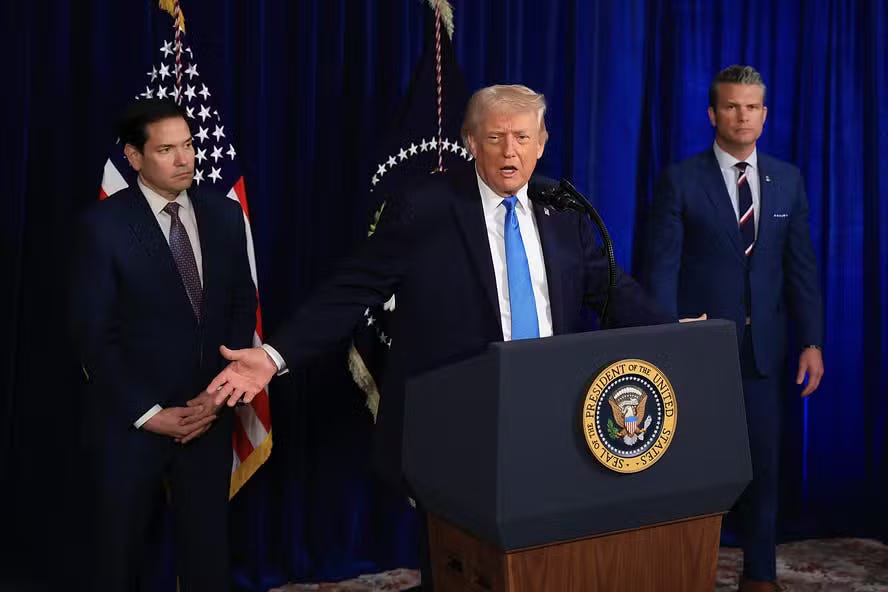
His public speech on the military incursion in Venezuela and kidnapping of Maduro - who was, whether you like him or not, the governing president of the country - followed a completely different version than if someone like Bush would have done it. Venezuelans should be happy that Maduro is out, because, according to Trump, a lot of them wanted Maduro out anyway and because now, with the US in control, they will be happy, they will know things will be better, and they'll benefit from all the oil that Trump and US companies will develop and sell on their behalf.
Maduro stood in the way of the oil grab, so he had to be removed. It had nothing to do with how Maduro was governing and it wasn't even about fear of the chavista 21st Century Socialism and what it represented. It is not that cold war-like - as much as this interpretation may be popular with the left.
The nationalisation of Venezuelan oil was a much older endeavour, dating back to 1976, when president Carlos Andrés Pérez tookover the petroleum industry. It was a time when other countries were also nationalising their oil supply, like Libya, Algeria and Iraq. For the US, this was bad news. As much as the country is an oil producer, its reserves pale in comparison to Saudi Arabia, for example, and later would be absolutely no match for Venezuela and its ginormous oil reserves.
This nationalisation process was actually quite organised. There was expropriation and annulment of contracts, with clear losses in terms of future profit for the US companies involved, but there were also agreements and some level of cooperation. In capitalist terms, the expropriation left the Venezuelan state indebted to the foreign oil companies due to contract breaches. In anti-imperialist reparation terms, the companies had already benefitted from way too many concessions and favours, so whatever was paid at the time should make them even.
The big oil grab
Yet, the US is using this episode of nationalisation to justify its next steps in Venezuela. Whereas a fictitious war on drugs is useful to persecute state leaders, as was part of the rationale for indicting Maduro and is also an element in Trump's accusations of Gustavo Petro in Colombia, it is too weak to ensure grabbing Venezuela's commodity sector and putting it under US control.
Since Trump's intervention has nothing to do with really helping the Venezuelan opposition - it was, in fact, this opposition helping Trump along the way - the point is to establish a rationale that would allow the US to take over the Venezuelan oil industry. For Trump, this is just taking back what the Venezuelan state took from US companies. Rather than trying to collect a supposed debt for the oil corporations, what Trump wants it full access to the Venezuelan soil. It is not about forsaken profit due to nationalisation; it is a clear message that if you nationalise and impede our access to resources, we can find an excuse to take over everything.
Strangely, in Latin America, it is very common for the developmentalist left to claim that it absolutely has to drill for fossil fuels, because, if we don't do it, the imperialist will come and take them. There's a fantasy that the imperialists can only take what was not developed yet, rather than whole industries. The Venezuelan case is proof that this doesn't matter. As long as the world is powered by fossil fuels, imperialists can wage war and coups to take them.
While, of course, this calls on us to develop a better strategy for sovereignty - which I elaborate on as ecological sovereignty in a previous post - I'd like to call attention to something else. As the race of critical minerals is also determinant of geopolitics, especially in a green transition marked by capitalists interests and technologies, many countries are keen on nationalising their lithium or their rare-earth minerals before it is too late. Brazil, for example, is working on a rare-earth policy, given its vast reserves, but foreign corporations are already operating in the country before we get to say that the “Neodymium is ours"!
In fact, just like with oil, a battle for the ecological future of the planet is at stake here. Clearly, some extraction and mining has to occur to promote the climate transition, but the current system is uncoordinated and based on capitalist goals, not one that could determine how much extraction is allowed, at what price, at what conditions and for what purposes. As capitalist extractivism stands today, everything is up for grabs. Sacrifice zones are normalised and the only thing that matters is how much countries will get to negotiate with national and multinational corporations to determine the share of the bounty.
Undue compensation
The issue is that, more recently, attempts to nationalise natural resources, to close down harmful operations or to at least determine the form and purpose of extraction have been met with a series of pressure tools by foreign corporations and their states. When the people of Panama decided they did not want a Canadian cooper mine to continue to operate, as their contract was in conflict with the national mineral policy and their environmental laws, the company filed an arbitration lawsuit claiming damages that could sink Panama's economy if the state had to fully pay them. As a result, the state is now inclined to extend the operations of the company.
Other countries, such as Honduras, have been a major target for these type of lawsuits, known as Investor-State Dispute Settlements. So, when Trump decided to directly support a candidate in Honduras, it was not because we was concerned with the Xiomara Castro government or even the fact that the left was reorganising within that country. Honduras does not mean that much ideologically to Trump. But when Honduras says no to special economic zones and unrestricted mining, it gets in the way of the commodity flow. And Trump really cares for the commodity flow.
His interests in Argentina, Colombia, Chile and more are all related. It is, obviously, advantageous for Trump to have ideological partners in the region, but it would do him no good if all Kast did in Chile was praise Trump and talk shit about immigrants. Trump wants that lithium just as much as he wants to keep oil flowing as if there was no climate change at all. You don't need to be a green capitalist to want to secure of the strategic minerals possible, you just need to be a capitalist.
This is why it matters a lot that Trump is justifying occupying Venezuela economically and politically for a while - maybe a long while - as (1) payment compensation due to nationalisation and as (2) power to actually produce and develop the resource in question to the fullest. He gets to grab resources with a value much larger than whatever the companies supposedly lost in revenue while strengthening monopoly power that will shut up dissent from other nations looking to buy that resource. If, before, you couldn't buy Venezuelan oil because of the sanctions, now you get to buy it from the country that applied those sanctions. It's a genius evil capitalist move.
This move sends a message about resource nationalisation. From the ecological standpoint, it shows that resource nationalism is not enough to ensure sovereignty, while deepening a destructive logic of global production. From the security standpoint, it shows that any country can be targeted if they nationalise industries where there was previous US investment. It sends a message about national policies for oil and minerals that treat these resources as national, but are ceded in partnership contracts to multinational corporations too. It seems that if you nationalise anything that was once touched by the devil, the devil will come back to take it all.
It calls us to take international solidarity to the next level. As much as the current situation is about Venezuela, it is clearly not just about Venezuela. Resource nationalisation leaves us vulnerable to lawsuits, sanctions, and wars. Many countries have lived through all modalities of this for simply denying unrestricted access to the US companies. But, if in the past, the US had to orchestrate elaborate coups or to go through the trouble of pretending to replace a regime in the name of democracy, now regime change and resource ownership change can go openly hand-in-hand. To survive this, we need to assert our sovereignty, yes, but we also really need a change in the global paradigm of production where industries and goods are refashioned in a post-extractivist logic.
As it stands today, as long as there are many buyers for these resources, with no concern for how they were grabbed and extracted, some imperialist is on the lookout. As it stands today, having a healthy liberal democracy at home won't protect us either (the tariffs were proof of this!). To slow down US imperialism, we need to stand up to Trump today as he looks to expand their zone of influence, but to truly stop it, we need an eco-social transition that revalues resources, their use, and makes some of them - especially fossil fuels - so obsolete for global production that it won't be worth it to wage wars for them anymore.
Ecological sovereignty: from mutual annihilation to true planetary longevity?

A couple of years ago, I published a short piece named “Sovereignty and the polycrisis” to reflect on how limited this framework has been in contexts of global disaster: wars, pandemics, climate change. The Westphalian state sovereignty system still dominates understandings of resource use and extraction, territorial control, borders, economic growth an…
Muito bom o texto! Ótima síntese.
Ótimo texto!
Nós estamos numa enrascada.
Pior é a sensação (sendo generoso) de que o Brasil já entregou o que tinha que entregar, por ora, pra garantir que não ocorram intervenções no curto prazo...
De um modo geral, estamos cercados de entreguistas/vassalos e de entreguistas disfarçados...
As operações das mineradoras em Minas Gerais, por exemplo, mostram de maneira cabal que mesmo a famigerada transição energética está ancorada em pura exploração/extrativismo colonial...